Your office needs another meeting room.
The question is: do you build one, or install an office pod instead?
Traditionally, businesses had one option: construction. Build walls, install a door, run electrical, modify ventilation, add lighting, acoustic treatment and furniture, and turn part of the office into another permanent room.
Today, premium office pods offer another solution.
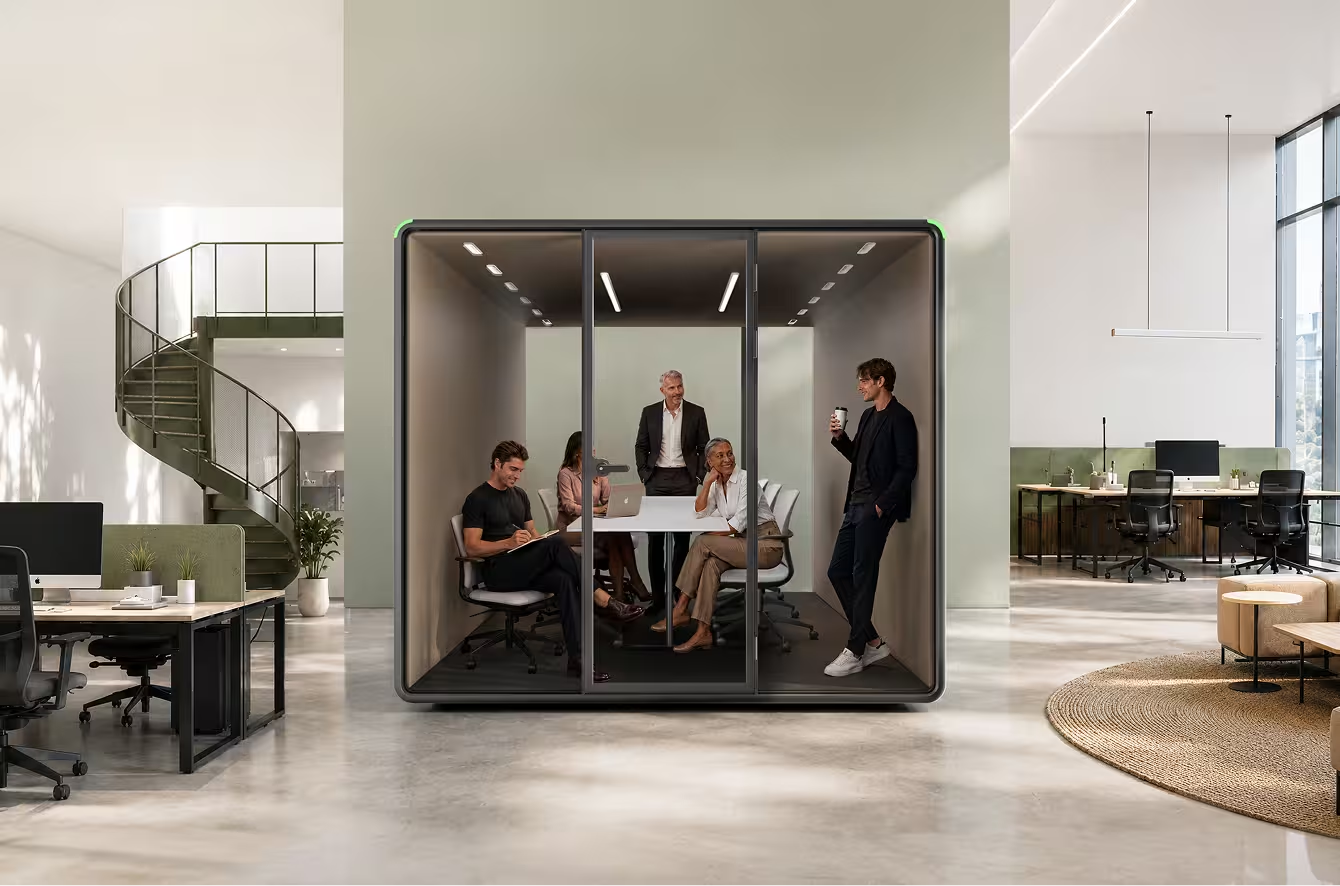
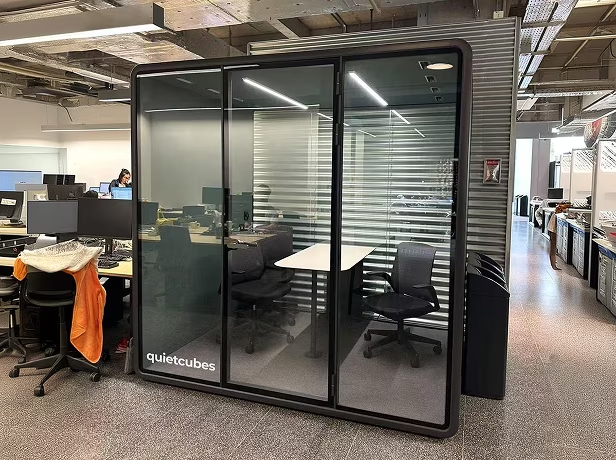
At QuietCubes, our larger office pods can create private meeting spaces for 4, 6 or even 8–10 people without committing to permanent construction.
So, which is more cost-effective?
Office Pod vs Traditional Meeting Room
Premium Office PodTraditional Meeting RoomUpfront costPredictableProject-dependentConstructionMinimalSignificantInstallationTypically fastCan take considerably longerElectricalIntegratedUsually installed separatelyVentilationIntegratedMay require HVAC workLightingIntegratedRequires installationAcousticsEngineered into podMust be designedFurnitureConfigurablePurchased separatelyRelocatableYesNoDisruptionLowPotentially significantStructural changesMinimalUsually permanent
Traditional meeting rooms still have their place. But for businesses adding private spaces to an existing office, permanent construction isn't necessarily the most practical option anymore.
How Much Does an Office Meeting Pod Cost?
QuietCubes' larger meeting pods currently start from:
- 4 Person Pod — $15,250 USD
- 6 Person Pod — $18,250 USD
- 8–10 Person Pod — $22,250 USD
These prices are for the base pod before optional furniture and upgrades.
For example, our 6 Person Pod can be configured with six chairs and a meeting table for an additional $2,225, bringing the total to approximately:
$20,475 USD
Our 8–10 Person Pod with ten chairs and a meeting table comes to approximately:
$25,475 USD
before additional optional upgrades.
You're also getting more than walls and furniture. A premium QuietCubes is already engineered with acoustics, ventilation, lighting and electrical functionality integrated into the pod.
That's where the comparison with traditional construction becomes interesting.
How Much Does a Traditional Meeting Room Cost?
There's no simple answer.
The cost of building a meeting room can vary dramatically depending on the location, building and specification.
Businesses may need to account for:
- Contractors and construction
- Electrical work
- HVAC modifications
- Acoustic treatment
- Glass and doors
- Flooring and ceilings
- Lighting
- Fire requirements
- Permits and approvals
- Furniture
- Technology
- Project management
That's why comparing an office pod against the cost of simply building partition walls isn't particularly useful.
The fair comparison is:
Complete office pod vs complete, finished meeting room.
Don't Forget the Cost of Disruption
Construction happens inside your workplace.
That can mean contractors, materials, drilling, dust, noise and areas of the office becoming temporarily unavailable.
Employees may need to move, meetings can be interrupted and facilities teams have another project to coordinate.
If you're completing an entire office fit-out, that's expected.
But if your only problem is:
"We need another six-person meeting room."
Is another construction project really necessary?
An office pod approaches the problem differently.
Rather than modifying the building to create a room, the room arrives as a modular product designed to be assembled within your existing space.
The Biggest Difference: Office Pods Can Move
This is one of the most overlooked financial advantages of office pods.
Imagine spending thousands building a beautiful meeting room inside a leased office.
Three years later, your company moves.
What happens to that meeting room?
It stays there.
The walls stay. The electrical work stays. The HVAC modifications stay.
A modular office pod is different.
It can be disassembled and potentially relocated elsewhere in the workplace or moved with the company to another office.
That changes the financial calculation.
Instead of only asking:
"How much does this room cost?"
Ask:
"What happens to our investment when our workplace changes?"
Businesses grow. Teams restructure. Hybrid working changes space requirements. Offices relocate.
A movable room has value because it doesn't assume your workplace will look exactly the same five years from now.
What About Soundproofing?
A traditional meeting room can provide excellent acoustic privacy — if it's designed and constructed correctly.
But good acoustics aren't automatic.
Walls, doors, glazing, ceilings and ventilation all affect how sound travels through a room.
With a premium office pod, acoustic performance is already engineered into the product.
QuietCubes pods achieve approximately 30 dB of speech level reduction, with acoustic performance tested to the ISO 23351 standard.
That gives businesses something valuable:
Predictability.
For interviews, HR discussions, team meetings and confidential conversations, you know you're purchasing a product designed specifically around acoustic privacy.
Ventilation, Power and Lighting Matter Too
Put six or ten people inside an enclosed room and ventilation quickly becomes important.
Traditional meeting rooms generally rely on the building's HVAC system, potentially requiring changes to ducting, vents and airflow.
Premium office pods have ventilation integrated directly into the product.
QuietCubes' ventilation system provides airflow of up to approximately 148 m³/h, helping continuously refresh the air inside.
The same applies to lighting and electrical functionality.
These systems are already integrated into the pod rather than needing to be designed and installed as separate parts of a construction project.
That's why office pods should be compared with a finished meeting room, not simply four newly constructed walls.
When Does Traditional Construction Make More Sense?
Office pods aren't the answer to every situation.
A traditional meeting room may make more sense when:
- You're completing an entire office fit-out
- You need a very large boardroom
- Specialized infrastructure is required
- The room will remain permanently in one location
- You're already undertaking significant construction
- Architectural integration is the priority
But if you simply need additional private meeting spaces inside an existing workplace, office pods deserve serious consideration.
When Does an Office Pod Make More Sense?
Office pods are particularly compelling when:
- You need meeting rooms quickly
- Your office is already operational
- You want minimal construction disruption
- You're leasing the building
- Your company may relocate
- Meeting rooms are constantly booked
- Your workplace layout may change
- You need predictable acoustic performance
- You operate across multiple locations
The real value isn't simply another room.
It's flexibility.
Is an Office Pod Actually Cheaper?
Sometimes.
Depending on your location and project requirements, traditional construction may be cheaper, similar in price or considerably more expensive.
We don't believe it's responsible to claim that an office pod will always save a specific percentage.
Instead, compare total value.
For traditional construction, consider:
Construction + electrical + HVAC + acoustics + lighting + furniture + permits + project management + disruption.
For an office pod:
Pod + furniture + optional upgrades + installation.
Then ask one final question:
What happens if we move?
A traditional meeting room becomes part of the building.
A premium office pod becomes part of your workplace infrastructure.
Frequently Asked Questions
Are office pods cheaper than building meeting rooms?
They can be. However, businesses should compare the total finished cost of both options rather than comparing an office pod against the cost of partition walls alone.
How much does a meeting office pod cost?
QuietCubes meeting pods currently start from $15,250 USD for a 4 Person Pod, $18,250 USD for a 6 Person Pod and $22,250 USD for an 8–10 Person Pod, before furniture and optional upgrades.
Can office pods replace meeting rooms?
For many everyday workplace applications, yes. Larger pods can provide enclosed spaces for meetings, interviews, presentations and collaborative work.
Can office pods be moved?
Yes. Unlike permanent meeting rooms, modular office pods can be disassembled and potentially relocated within the workplace or moved to another location.
Are QuietCubes office pods soundproof?
QuietCubes pods are designed to significantly reduce speech transmission rather than create absolute silence, achieving approximately 30 dB speech level reduction with acoustic performance tested to ISO 23351.
So, Which Is More Cost-Effective?
If you're designing a new office from scratch and know exactly where your meeting rooms will remain for years, traditional construction can make perfect sense.
But modern workplaces aren't always that predictable.
Companies grow. Teams change. Offices move. Space requirements evolve.
That's why QuietCubes is designed around a different idea:
Your workplace should be able to change with your business.
From a 4 Person meeting pod starting at $15,250 USD to an 8–10 Person conference pod from $22,250 USD, QuietCubes provides premium private meeting spaces without automatically turning every new room into another permanent construction project.
The biggest difference is simple:
A traditional meeting room becomes part of your building.
A QuietCubes becomes part of your business.
Questions


.png)